Khwaja Shams-ud-Din Muhammad Hafez-e Shirazi

Hafez
of Shiraz

خواجه حافظِ شیرازی
c. 1315–1390 CE — Shiraz, Fars Province, Iran

Hafez is considered the supreme master of the Persian ghazal — a title no other poet has seriously contested in seven centuries. His Divan of approximately 500 ghazals has been memorised by generations of Iranians, recited at births and funerals, and used as a form of divination (Fal-e Hafez).

His verses operate simultaneously on multiple levels — the literal (wine, the tavern, the Beloved) and the mystical (divine intoxication, Sufi longing, union with God). This deliberate ambiguity is the source of the Divan's inexhaustible richness. No two readers agree on which reading is the "correct" one — and Hafez intended it that way.

~500
Ghazals
~5,000
Couplets
2
Volumes
700+
Years of reading
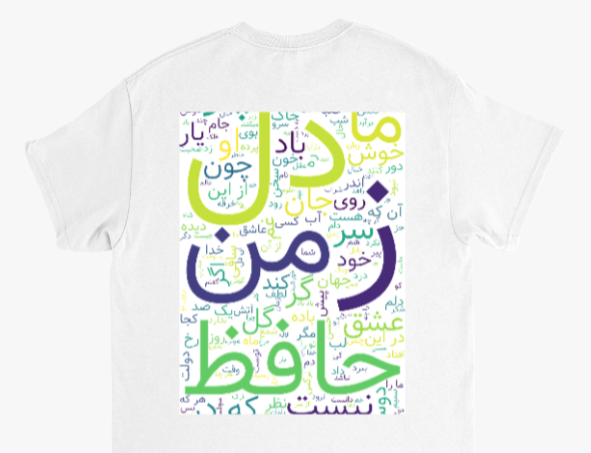
Word Map of Divan-e Hafez — نقشهٔ واژگانی
Word Map of Divan-e Hafez

Ghazal 1 — The Opening Poem

The first ghazal of the Divan — one of the most famous opening lines in all of Persian poetry. Toggle between English and Farsi.

Ghazal 1 — Opening Couplet (Matla) Oh dearest cupbearer, pass the wine around — For love seemed easy at first, but then difficulties were found.
By the breeze of the musk-deer's breath that the morning wind will bring, The knotted locks of the dark-haired Beloved will be unbound.
In the station where I dwell, what peace can I find? Every moment the sound of the departure bell is all around.
Paint the prayer-robe wine-coloured — as the wise old master ordained — For in the traveller's way, the craft of the stain is sound.
Maqta — Closing Couplet (Pen Name) Hafez — do not abandon the Quran's company and the path of the wise; Even if you go to the one whose ways enchant and astound.
غزلِ اوّل — مطلع الا یا ایها الساقی ادر کأساً و ناولها که عشق آسان نمود اوّل ولی افتاد مشکل‌ها
به بویِ نافهٔ کاوّل بِصبحِ آرَد پیمانه هنوز آشفتهٔ آن زلفِ عنبرآسا باید
بِشویَم خِرقه در می‌خانه‌ای پیرِ مغان گفتا گرَت پیر مغان گوید بر آتش نه مسلم شو
بنال بلبل اگر با منت سرِ یاری است که ما دو عاشقِ زاری و بی‌قرار و حزینیم
مقطع — بیتِ آخر حافظ در این مقام مشو غافل از ادب زیرا که هر که رفت ازین راه بی‌ادب برگشت

Hafez — The Tongue of the Unseen

Khwaja Shams-ud-Din Muhammad Hafez-e Shirazi was born in Shiraz around 1315 CE. His pen name "Hafez" (حافظ) means "one who has memorised the Quran" — indicating that he had committed the entire Quran to memory in his youth. He spent almost his entire life in Shiraz and died there around 1390 CE.

Hafez composed under the patronage of various rulers of the Injuid and Muzaffarid dynasties in Shiraz. His poetry is celebrated for operating simultaneously on the literal and the mystical: wine, the tavern, the Beloved, and the cupbearer all carry double meanings — earthly pleasure on one level, divine intoxication and Sufi mysticism on another.

His Divan contains approximately 500 ghazals, several qasidas, and other verse forms. In Iran, the Divan-e Hafez is the second most widely owned book after the Quran. It is used as an oracle (Fal-e Hafez) — readers open it at random to receive a verse as a reply to their unspoken question or wish.

"Last night at dawn, they freed me from grief —
And in that darkness gave me the water of life."
دوش وقتِ سحر از غصّه نجاتم دادند
وندر آن ظلمتِ شب آبِ حیاتم دادند
Hafez — Divan, Ghazal 2
Key Facts — Divan-e Hafez
Full NameKhwaja Shams-ud-Din Muhammad Hafez-e Shirazi
Pen NameHafez (حافظ) — one who has memorised the Quran
Bornc. 1315 CE, Shiraz, Fars Province
Diedc. 1390 CE, Shiraz, Fars Province
GenreLyric ghazal (غزل), qasida, rubaiyat
Ghazals~500 ghazals, ~5,000 couplets
Our Edition2 bilingual volumes — line by line
ThemesLove, wine, the Beloved, Sufi mysticism, impermanence
Special UseFal-e Hafez — the Divan used as an oracle
TombHafezieh, Shiraz — a revered pilgrimage site

Anatomy of a Hafez Ghazal

The ghazal (غزل) is a form of lyric poetry with a strict structure — rhyming couplets sharing a single end-rhyme and refrain, with the poet's pen name (takhallus) embedded in the final couplet. Hafez mastered this form to a degree that has never been equalled.

Each ghazal in the Divan typically contains 5 to 12 couplets (sher/beyt). Our line-by-line translation preserves the couplet structure — Farsi original above, English translation below each couplet — so readers can follow both simultaneously.

The extraordinary challenge of translating Hafez is that his images are radically ambiguous by design. When he writes of wine (می) and the cupbearer (ساقی), he simultaneously means both earthly wine and divine intoxication. Our translation prioritises faithfulness to the literal text, allowing readers to bring their own interpretation.

Ghazal Structure — Key Terms
Matla (Opening Couplet) مطلع
The first couplet — both hemistiches rhyme. Sets the radif (refrain) and rhyme scheme for the entire ghazal. Often the most memorable couplet.
Beyt / Sher (Couplet) بیت / شعر
The basic unit — two hemistiches (misra). Only the second hemistich rhymes in the middle couplets. A typical Hafez ghazal has 5–12 couplets.
Radif (Refrain) ردیف
A word or phrase that repeats at the end of each couplet after the rhyme. Hafez's mastery of the radif — making it feel fresh each time — is one of his greatest achievements.
Qafia (Rhyme) قافیه
The rhyming word immediately before the radif. Every couplet must end with the same qafia + radif combination — a strict constraint Hafez turns into art.
Maqta (Closing Couplet) مقطع
The final couplet — always contains the poet's pen name (takhallus). Hafez often addresses himself in the third person: "Hafez, do not abandon…"
Takhallus (Pen Name) تخلّص
The poet's signature embedded in the maqta — "Hafez" (حافظ). This allows identification of authentic ghazals and is the formal seal of the poem.

The Bilingual Hafez Series

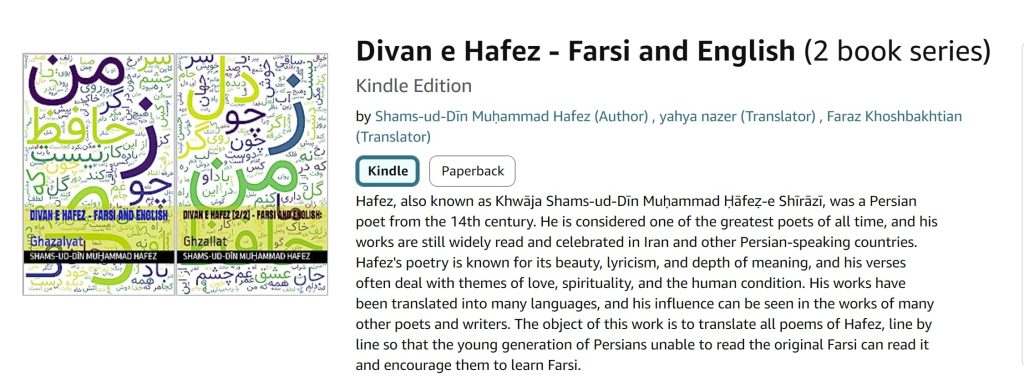
The complete Divan-e Hafez translated line by line — Farsi original alongside faithful English translation — published in two volumes. Each volume available in Kindle and Paperback on Amazon.

Divan-e Hafez — Amazon Series
01
Ghazals 1 to 245
غزل‌های ۱ تا ۲۴۵

Divan-e Hafez — Vol. 1

Line-by-line bilingual edition
Buy on Amazon
02
Ghazals 246 to 500
غزل‌های ۲۴۶ تا ۵۰۰

Divan-e Hafez — Vol. 2

Line-by-line bilingual edition
Buy on Amazon

Famous Opening Lines (Matla)

A selection of the most celebrated opening couplets (matla) from the Divan — each one the beginning of a complete ghazal available in the bilingual edition.

#Opening Line — EnglishThemeمطلعِ غزل
1"Oh dearest cupbearer, pass the wine — for love seemed easy at first, but then difficulties were found."Love & Sufi initiationالا یا ایها الساقی ادر کأساً و ناولها
2"Last night at dawn they freed me from grief — and in that darkness gave me the water of life."Mystical graceدوش وقتِ سحر از غصّه نجاتم دادند
3"Where is the path of virtue, and where am I in my ruin? See the distance between the road and where I stand."Longing & separationصلاحِ کار کجا و منِ خراب کجا
4"Come — for the palace of hope is built on very weak foundations; bring wine, for the foundations of life rest on the wind."Impermanenceبیا که قصرِ اَمَل سخت سست بنیاد است
5"Oh wild deer, where are you? I have such great familiarity with you."The Beloved & longingالا ای آهویِ وحشی کجایی
6"The breeze of morning carries the scent of love — rejoice, for the world works according to our wish."Hope & divine loveنسیمِ صبح سعادت بدان نشان که توراست
7"Reveal your face — for my desire is a garden and a flower-bed; open your lips, for my wish is abundant sweetness."The Beloved's beautyبنمای رخ که باغ و گلستانم آرزوست
8"I am a wandering dervish, a dust-worn traveller — where is the tavern, for I have been astray for a long time."Sufi wanderingمنم که شهرهٔ شهرم به عشق ورزیدن
9"The morning breeze has arrived — time to rejoice; the friend has arrived — time to drink wine."Joy & the belovedصبا وقتِ سحر بویِ خوشی می‌آمد
10"Do not grieve, for all secrets will be revealed — and the dark night will pass, and daylight will come."Hope & patienceدل را به کف آر، ای دوست، که شب تاریک است
11"Neither my heart can stand without the tavern nor my hand without wine — what shall I do with these two stubborn companions?"Devotion to loveنه هر که چهره برافروخت دلبری داند
12"Heart-devotion and sincerity — this is the way of the dervish; when these two come together, love's secret is revealed."Sufi loveوفاداری و صدق و راستی داشتم
13"Carry the cup of Jamshid in your hand and be a discerner of the world — ask Jamshid's cup to show the face of the Beloved."Wisdom & visionجامِ جم آنچنان که معلوم تو شد
14"I am the slave of the determination of him who, beneath heaven's blue dome, is free from all colourings."Freedom & spiritualityغلامِ همّتِ آنم که زیرِ چرخِ کبود
15"Where is the rose without the thorn? And where is joy without sorrow? Be patient — for this is the way of the world."Acceptance & patienceکجاست گل بی‌خار و کجاست لذت بی‌رنج
16"I said: O fortune, you slept and the sun rose — she said: despite all of this, do not be hopeless."Hope & fortuneگفتم ای سلطانِ خوبان رحم کن بر این غریب
17"My heart wanted the Beloved's cheek — I said: perhaps; but perhaps not. Let us see what fate has in store."Desire & fateدلم خواست آن رخسارِ دوست را
18"Every morning the breath of the east wind brings a message from the Beloved — 'Come, for the season of the rose has arrived.'"Spring & renewalصبا به مهربانی بیا و پیغامِ یار بیار
19"Bring wine — for in the monastery I saw no sincerity; go, Hafez, and seek refuge in the magi's tavern."Disillusionment & Sufismمی بده کز خانقه ام دیدی صادق نبود
20"What remedy is there for the pain of love? There is no remedy — except for patience and the passage of time."Love's painچارهٔ دردِ عشق چیست — صبر است و گذشتِ روز

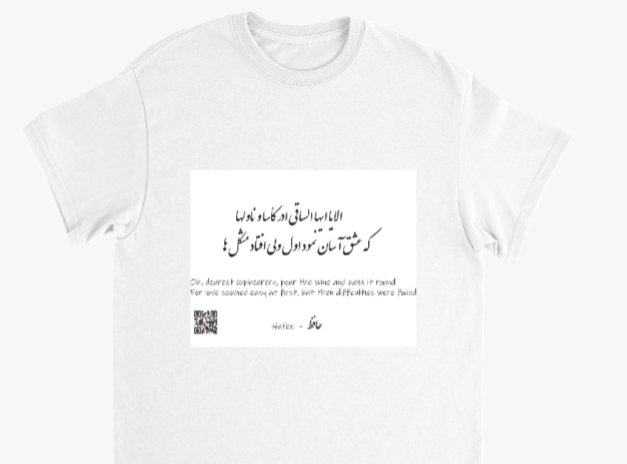
Hafez 001 — Poetry T‑Shirt

Wear the opening verse of Hafez's most celebrated ghazal — Farsi on the front, English on the back. Heavyweight unisex crewneck, all sizes available on Etsy.

الا یا ایها الساقی ادر کأساً و ناولها
که عشق آسان نمود اوّل ولی افتاد مشکل‌ها
"Oh dearest cupbearer, pass the wine and pass it round —
For love seemed easy at first, but then difficulties were found."
Buy on Etsy
Hafez T-Shirt — Front Hafez T-Shirt — Back
Shahnameh
Continue Reading
Up Next — Divan-e Shams (Rumi)
Divan-e Shams